
The 9 Best AI Blog Writing Service Options in 2026 (Tested and Reviewed)

Founder of OGTool, Ex-Stanford, Bootstrapped to $1M organically
The best AI blog writing service in 2026 is OGTool for teams that need every post tied to a tracked Google, AI Overview, or ChatGPT result, while Surfer AI is the strongest self-serve pick for pure SEO drafting, ChatGPT is the best free option, and Koala AI is the best value for solo bloggers. Below we review nine options, with pricing, best-for tags, and a side-by-side table.
We run OGTool, so read this knowing where we stand. We tested each option against identical briefs, scored the output, and checked prices on the vendor pages as of October 2026.
The market has real quality in it now. The problem is no longer whether an AI can write a readable draft. The problem is that most tools hand you words and walk away, and words that never rank are a cost, not an asset.
What is an AI blog writing service, and how is it different from ChatGPT?
An AI blog writing service produces finished, SEO-shaped blog posts from a keyword or brief, usually with research, outlining, optimization scoring, and sometimes publishing built in. ChatGPT is a general chatbot: it writes whatever you prompt, but it does no keyword research, no SERP analysis, no CMS publishing, and no rank tracking on its own.
The search term hides three different products, and most ranking pages blur them together:
- AI writing assistant. ChatGPT, Jasper, Rytr. You prompt, it drafts, you do everything else. Cheapest per word, highest editing load.
- AI blog generator. Surfer AI, Koala, Writesonic. You enter a keyword, it researches the SERP and produces a long-form post with headings and optimization scoring. Less prompting, still your job to edit, publish, and measure.
- Done-for-you AI blog writing service. OGTool's GEO plan and managed service. Keyword selection, drafting, human review, publishing, and daily tracking of what ranked. You approve, the service ships and reports.
If you literally searched for a service rather than a tool, only the third category delivers what the word means. The rest of this post treats both honestly, because many teams want a tool and only discover later that the gap between a draft and a ranking is where their budget disappears. Our breakdown of what a content marketing service actually buys you covers that gap in more depth.
How did we test these AI blog writing services?
We gave every tool the same three briefs: one informational keyword, one commercial comparison keyword, and one niche B2B SaaS question. We scored each output on accuracy, SEO structure, brand voice fit, and how much editing it needed before publishing. We then checked list pricing, free plans, and CMS integrations on each vendor's site as of October 2026.
Our five scoring criteria, weighted roughly equally:
- Content quality. Factual accuracy, hallucination rate, and whether the post actually answered the query or circled it.
- SEO research. Does the tool pull SERP data, suggest terms, and score the draft, or does it just write?
- Brand voice. Can it ingest a knowledge base, tone guide, and product facts, and does the output reflect them?
- Workflow. Images, internal links, meta data, CMS publishing, and tracking after publish.
- Price and total cost. Subscription plus the editing hours a draft needs before it is safe to publish.
One caveat on the vendor-written listicles currently ranking for this query: most rank their own product first and show no sample outputs. We rank ourselves first too, so we have stated exactly where OGTool loses below, and we show a per-article cost model you can check against your own numbers.
[Image placeholder: ai blog writing service testing scorecard across nine tools]
Which are the best AI blog writing services and tools in 2026?
OGTool is the best overall for teams that want published posts tied to tracked rankings, Surfer AI is best for SEO-first self-serve drafting, ChatGPT is best free, Koala AI is best value for small teams, and Jasper is best for marketing teams that need brand voice across many formats. Here are all nine, reviewed in order.
1. OGTool (best overall for ranking outcomes)
OGTool is an AI visibility platform that generates a full AEO-optimized blog post per tracked keyword, publishes it, and then watches Google, AI Overviews, and ChatGPT daily to tell you whether the post earned a citation. The GEO plan includes one AEO-optimized blog per week, daily ChatGPT tracking, and a live dashboard with revenue attribution. A fully managed option runs the whole program for you.
Key features: keyword-first generation, client knowledge base, images, and videos pulled into every post, publishing to your CMS or hosted via a subdirectory setup, a wins log that records every citation, and competitor article intelligence that shows which rival pages ChatGPT is citing so you can target the same keyword.
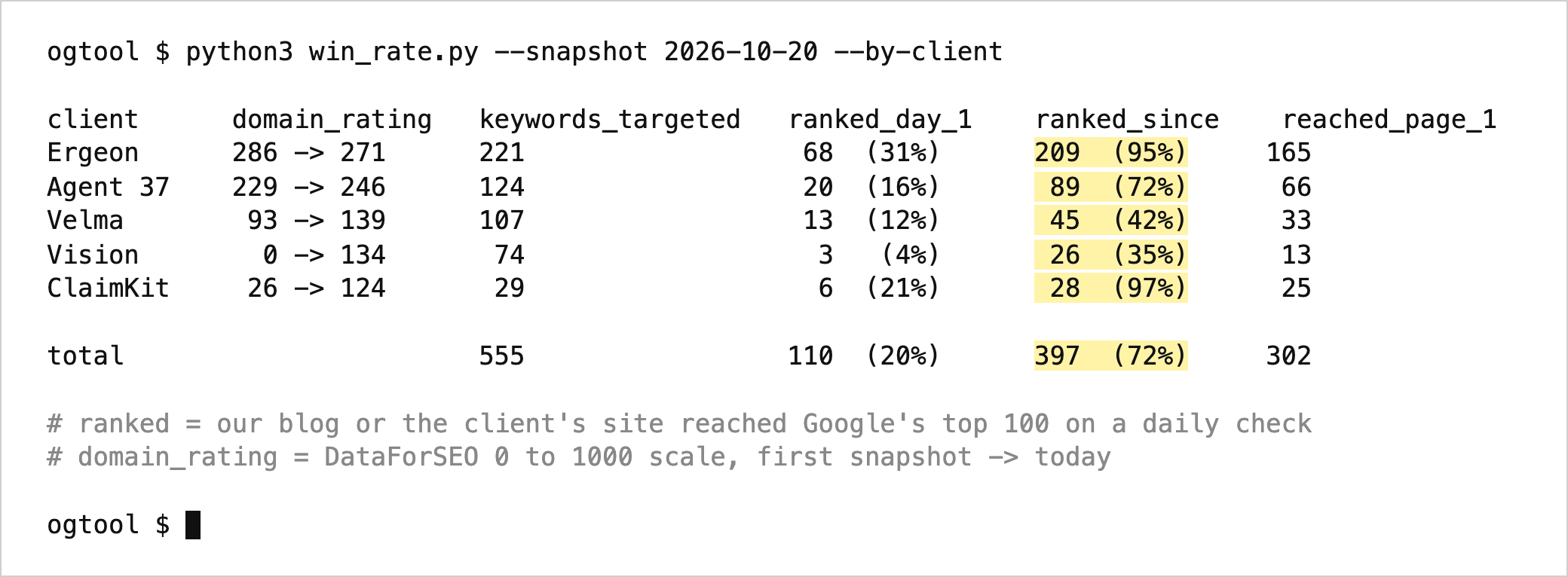
Pros: clients report 3% of content detected as AI versus 44% with competing generators. First wins typically land in roughly 14 days, and some clients have been mentioned in ChatGPT within 24 hours. Across clients the loop has produced 129 Google front-page wins and $88,000 in attributed revenue, and Kea.ai now gets 70% of its leads from ChatGPT from posts generated this way.
Cons: it is built for coverage, not founder essays. If the writing itself is the product, hire a human. It also assumes you care about AI search, so a blog that only needs occasional lifestyle content will not use half the platform.
Pricing: self-serve plans and the GEO plan are listed on the pricing page; managed service is quoted per engagement.
Best for: B2B SaaS and growth teams that want keyword coverage published, tracked, and attributed without project-managing writers.
2. ChatGPT (best free option)
ChatGPT remains the most capable general writer on this list and the only one you can use seriously at no cost. With a detailed prompt, a pasted outline, and your product facts, it produces clean 1,500-word drafts in under a minute.
Pros: free tier is genuinely usable, strong reasoning, handles rewrites and tone changes well. Cons: no keyword research, no SERP data, no optimization score, no publishing, and it will confidently invent statistics unless you supply sources. Everything after the draft is manual.
Pricing: free; ChatGPT Plus is about $20 per month as of October 2026, verify on OpenAI's site.
Best for: solo bloggers and teams that already have an SEO process and only need a fast, capable drafter.
3. Jasper (best for brand voice across formats)
Jasper is the incumbent marketing AI, with brand voice profiles, a knowledge base, team workspaces, and templates for everything from blog posts to ad copy. Its blog output was consistently on-tone in our test once a voice profile was trained.
Pros: best brand voice controls among the generators, strong collaboration, Surfer integration for SEO scoring. Cons: SEO research is an add-on, not native, and the price climbs fast for teams. Drafts still needed fact checking in every brief.
Pricing: roughly $39 to $69 per seat per month depending on plan and billing, as of October 2026; verify on jasper.ai.
Best for: marketing teams producing many content types that need a single, trained house voice.
4. Copy.ai (best for workflow automation)
Copy.ai has pivoted from a copywriting assistant to a workflow platform that chains research, drafting, and formatting steps. Blog generation is one workflow among many, which is both its strength and its weakness.
Pros: workflows can pull from your data and produce structured posts repeatedly, free plan exists. Cons: blog-specific SEO features are thin, and the per-article output was the most generic in our test without heavy prompt engineering.
Pricing: free tier with limits; paid plans start around $49 per month as of October 2026, verify on copy.ai.
Best for: growth teams that want automated content pipelines and already handle SEO elsewhere.
5. Writesonic (best for all-in-one SEO drafting on a budget)
Writesonic bundles an AI article writer with keyword research, SERP analysis, and a Chatsonic assistant. Its long-form writer produces publish-shaped posts with headings, meta data, and images in a single run.
Pros: real SEO research built in, WordPress publishing, images generated inline. Cons: quality varied widely across our three briefs, and the niche B2B post contained two invented claims we had to remove.
Pricing: free trial; paid plans from roughly $39 to $99 per month as of October 2026, verify on writesonic.com.
Best for: small teams that want keyword research and drafting in one subscription.
6. Surfer AI (best for SEO-first self-serve drafting)
Surfer AI sits on top of Surfer's content editor, so every generated post is scored against the live SERP for terms, headings, and length. In our test it produced the most SEO-complete drafts of any self-serve tool.
Pros: best optimization scoring, SERP-grounded outlines, anti-AI-detection mode, integrations with WordPress, Jasper, and Google Docs. Cons: articles are purchased as add-ons on top of the subscription, so volume gets expensive, and voice fit was average. No post-publish rank tracking.
Pricing: Surfer plans from roughly $99 per month, with AI articles billed separately, as of October 2026; verify on surferseo.com.
Best for: SEO specialists who want a draft that scores well in the editor before they edit it.
7. Koala AI (best value for small teams)
Koala AI (KoalaWriter) is a focused long-form generator with real-time SERP research, automatic internal linking from your sitemap, and direct WordPress publishing. It is the cheapest tool here that still does genuine SEO research.
Pros: very low entry price, internal links and images included, Amazon product round-up templates. Cons: limited brand voice controls and no team features, and the output read noticeably templated across our three briefs.
Pricing: plans from roughly $9 to $49 per month as of October 2026, verify on koala.sh.
Best for: solo bloggers and affiliate sites that need volume at the lowest possible cost.
8. Rytr (best cheap assistant)
Rytr is a lightweight writing assistant with dozens of templates, tone options, and a permanent free plan. It writes sections and short posts well but is not built for 2,000-word SEO articles.
Pros: cheapest paid plan on the list, simple interface, free tier. Cons: no SEO research, short outputs, generic voice.
Pricing: free plan; paid plans from roughly $9 to $29 per month as of October 2026, verify on rytr.me.
Best for: occasional bloggers who want help with intros, outlines, and rewrites.
9. Frase and Clearscope (best for optimizing drafts you already have)
Frase and Clearscope are content optimization platforms first and writers second. Both analyze the SERP, build briefs, and score drafts; Frase adds an AI writer, Clearscope focuses on term coverage and grading.
Pros: best briefs and term reports in the category, trusted by agencies, strong Google Docs and WordPress integrations. Cons: AI drafting is secondary, and Clearscope is priced for teams, not individuals.
Pricing: Frase from roughly $45 per month; Clearscope from roughly $189 per month, as of October 2026, verify on each vendor's site.
Best for: content teams with human writers who want AI research and scoring rather than AI drafting.
How do the best AI blog writing tools compare side by side?
OGTool is the only option in this comparison that combines generation, publishing, and daily rank and citation tracking. Surfer AI, Koala, and Writesonic lead the self-serve tools on built-in SEO research. ChatGPT and Rytr are the only ones with a usable free plan, and Jasper leads on brand voice controls for larger teams.
| Tool | List price (Oct 2026, verify) | Free plan | SEO research | Output length | CMS publishing | Tracks results after publish | Best for |
|---|---|---|---|---|---|---|---|
| OGTool | See pricing page; GEO plan includes 1 AEO blog per week | No | Keyword-first, competitor citations | Full post with images, links, meta | Yes, or hosted | Yes, daily Google, AI Overview, ChatGPT | Ranking outcomes |
| ChatGPT | Free; Plus ~$20/mo | Yes | None | Any, prompt-dependent | No | No | Free drafting |
| Jasper | ~$39 to $69/seat/mo | Trial | Via Surfer add-on | Long-form | Via integrations | No | Brand voice |
| Copy.ai | ~$49/mo and up | Yes | Thin | Workflow-defined | Via integrations | No | Automation |
| Writesonic | ~$39 to $99/mo | Trial | Yes, built in | Long-form with images | WordPress | No | Budget all-in-one |
| Surfer AI | ~$99/mo plus per article | No | Best scoring | Long-form, SERP-matched | WordPress | No | SEO drafting |
| Koala AI | ~$9 to $49/mo | Trial | Yes, built in | Long-form with internal links | WordPress | No | Small teams |
| Rytr | Free; ~$9 to $29/mo | Yes | None | Short to medium | No | No | Cheap assistant |
| Frase / Clearscope | ~$45/mo; ~$189/mo | Trial | Best briefs | Draft support | Google Docs, WordPress | No | Optimizing drafts |
Two things stand out. First, every self-serve tool stops at publish; none tells you a week later whether the post earned a ranking or a ChatGPT mention. Second, the sticker price is the smallest part of the cost, which the next section shows.
[Image placeholder: ai blog writing service comparison table with pricing and SEO features]
How much does an AI blog writing service cost per article?
As of October 2026, a self-serve AI blog tool costs roughly $9 to $99 per month, which works out to under $5 per draft at volume, but each draft typically needs one to three hours of editing and fact checking before it is safe to publish. Add that labor and the real cost per article lands between $50 and $200. Human freelancers charge $150 to $500 or more per SEO post.
Here is the total cost of ownership model we use on demos:
- Raw generator draft. Subscription divided by posts, plus roughly 1 to 3 hours of editing at your loaded hourly rate. A $49 tool producing 20 posts a month at 2 hours each is about $2.50 in software and $100 to $200 in labor per post.
- Optimization platform plus writer. Clearscope or Frase at $45 to $189 per month, plus a freelancer at $150 to $500 per post, plus your own editing. Highest quality ceiling, highest cost.
- Done-for-you service. The subscription covers drafting, review, publishing, and tracking. The per-article number depends on cadence; OGTool's GEO plan includes one AEO-optimized blog per week, so divide the plan price on the pricing page by four to get your effective per-article rate before any labor savings.
The comparison most buyers skip is the cost of posts that never rank. A $100 draft that earns nothing is more expensive than a $300 post that wins a keyword. That is why OGTool reports per-post outcomes, and why the YC-backed company in our Reddit and blog case study could measure a 4x lower CAC rather than guess at it.
How do you get publish-ready output from an AI blog writer?
You get publish-ready output by feeding the tool a keyword, a specific brief, and your product facts, then running every draft through a fixed QA checklist before it ships. Tools that accept a knowledge base and pull SERP data produce far less generic output; tools that only take a prompt need the brief written into the prompt itself.
Six practices that moved our test scores the most:
- Start from a tracked keyword, not a topic. A post exists to win a query. Write the query into the H1 and the first sentence, and shape the opening paragraph as a direct answer that an AI engine can quote. Our guide to AEO versus SEO explains why answer-shaped structure matters more than it did two years ago.
- Load product facts and a voice sample. Jasper, OGTool, and Copy.ai accept a knowledge base. For ChatGPT, paste a 300-word voice sample and a fact sheet at the top of every session.
- Demand sources for every number. Ask the tool to cite where each statistic came from, then check it. Hallucinated numbers are the single most common way AI posts fail review.
- Add structured data and clean headings. Google's structured data documentation is the neutral reference; explicit markup reduces ambiguity about who you are and what the page answers.
- Publish into your main domain. Content on a subdomain splits authority. A reverse proxy subdirectory setup keeps every post under the root domain, which is how Kea.ai doubled month-over-month traffic.
- Measure after publish. Check rankings and AI citations daily for the first two weeks. If nothing moves by day 14 on a low-competition keyword, the post needs a rewrite, not patience.
Before any AI post goes live, run this QA checklist: facts verified against a source, no duplicate sections, brand claims match the product, internal links point to real pages, meta title and description set, images have descriptive alt text, and one human has read it start to finish. Google's own guidance on AI-generated content is clear that it rewards helpful content however it is produced and demotes content built primarily to manipulate rankings, so the checklist is your real protection, not the tool choice.
[Image placeholder: ai blog writing service editorial QA checklist before publishing]
What else do people ask about AI blog writing services?
The most common questions cover whether ChatGPT is enough, whether AI content is legal and safe to publish, whether a blog can run without an editor, and which option fits a small team. Here are direct answers to each, with the reasoning behind them.
Is there a better AI for blog writing than ChatGPT?
For raw drafting, ChatGPT is as good as any dedicated tool, and it is free. A dedicated tool becomes worth paying for when you need SERP research, optimization scoring, brand voice memory, CMS publishing, or tracking after publish. Surfer AI and Koala add the SEO layer; OGTool adds publishing and daily Google and ChatGPT tracking. If you only need words, stay with ChatGPT and a good prompt.
Is it illegal to publish a blog post or story written by AI?
No. Publishing AI-written content is legal in the United States and most jurisdictions. The nuance is ownership: the U.S. Copyright Office has stated that purely machine-generated material is not eligible for copyright protection without meaningful human authorship, so heavily edited AI posts are on firmer ground than untouched output. Disclose AI use where your platform or industry requires it.
Can I run an entire blog with AI, or do I still need a human editor?
You can generate and publish an entire blog with AI, but you should not skip a human review. In our test every tool produced at least one factual error across three briefs. A done-for-you service like OGTool keeps a review step in the loop, which is why clients report only 3% of content flagged as AI compared with 44% from competing generators. Keep a human on facts, claims, and brand voice.
Which AI blog writing service is best for a small team?
For a small team with zero in-house SEO, OGTool's GEO plan removes the most work because it selects keywords, writes, publishes, and reports wins; a national garage door company using the approach was mentioned in ChatGPT within 24 hours. If you have an SEO lead and just need cheap drafts, Koala AI at roughly $9 to $49 per month is the best value as of October 2026.
The fastest way to evaluate any AI blog writing service is to watch it work against your own keywords, so book a demo and we will pull up your baseline live.
Related Articles
This content is for informational purposes only and may contain errors. Please contact us to verify important details.