
Best ChatGPT Monitoring Tool in 2026: Top Picks Ranked and Compared

Founder of OGTool, Ex-Stanford, Bootstrapped to $1M organically
The best ChatGPT monitoring tool for most B2B SaaS and growth teams is OGTool, which combines daily brand tracking across ChatGPT with a Reddit and blog workflow that actively moves your visibility score. Below we compare OGTool alongside the other tools that appear most often across independent reviews, including Profound, Semrush AI Toolkit, Ahrefs Brand Radar, Otterly AI, Peec AI, SE Ranking, and SEOmonitor, so you can match the right platform to your team size and budget.
What is a ChatGPT monitoring tool and how is it different from Google rank tracking?
A ChatGPT monitoring tool runs a set of prompts against one or more large language models, then records whether your brand is mentioned, cited as a source, or recommended. Traditional rank trackers measure URL position for a keyword. AI visibility trackers measure whether your brand name appears inside an AI-generated answer, which source the model credits, and whether the mention is a passing reference or an active recommendation. The distinction matters because a page ranked third on Google earns clicks; a brand not mentioned by ChatGPT simply does not exist in that conversation.
The core shift is from keyword position to answer presence. According to a widely cited Sparktoro and Datos study on zero-click searches, more than 60 percent of searches now end without a click to any website. AI-generated answers accelerate that pattern. Monitoring tools built for this environment track prompts, not page crawls.
What is the difference between a ChatGPT mention, a citation, and a recommendation?
The three terms describe increasing levels of commercial value. A mention means your brand name appears somewhere in the response, often alongside a list of alternatives. A citation means the model attributes a specific fact or passage to your content, usually linking to a source URL. A recommendation means the model positions your product as a top or preferred choice for the user's specific need. Most monitoring tools can detect mentions; fewer reliably distinguish citations from recommendations, and that gap in specificity is a key evaluation criterion.
When you evaluate any tool, ask whether it flags the type of mention, not just the presence of your name. OGTool's daily ChatGPT tracking surfaces which keywords produce recommendation-level responses versus passing mentions, and alerts your team when a new citation is detected so you can trace which piece of content earned it. That attribution loop is what separates monitoring from optimization. You can see how this plays out in the Kea.ai case study, where citation-level tracking helped move the brand from zero to 70 percent of leads sourced from ChatGPT.
What metrics should a ChatGPT monitoring tool track?
The six metrics that matter most are brand mention frequency, citation rate, recommendation rate, share of voice against named competitors, sentiment score, and cited source breakdown. Share of voice tells you what percentage of AI responses for a given prompt category include your brand versus a competitor. Cited source breakdown tells you which of your URLs, Reddit threads, or third-party articles the model is pulling from, which makes it actionable.
Weaker tools surface only a binary yes-or-no for brand presence. Stronger tools show you the prompt text that triggered the mention, the position of your brand within the answer, the sentiment of the surrounding language, and the specific sources the model cited. OGTool adds a Wins log that records every new citation chronologically so teams can connect a published piece of content to a measurable visibility gain, rather than guessing which activities drove the result.
What are the top ChatGPT monitoring tools available in 2026?
The tools below appear consistently across independent reviews. Each entry covers the AI engines supported, key features, published pricing as of mid-2026, and the team type each tool fits best.
1. OGTool
OGTool is built for B2B SaaS founders and growth teams who need monitoring and a clear next step, not just a dashboard. Daily ChatGPT tracking runs against your chosen keywords, surfaces competitor content being cited, and generates a prioritized list of Reddit threads and blog topics to publish in response. The platform tracks when published content earns a new ChatGPT citation and logs each win in a running record your team can review weekly.
Engines covered: ChatGPT, Google AI features, Reddit-sourced citations
Key features: Daily keyword tracking, competitor citation monitoring, Reddit listening with comment drafts in your brand voice, AEO blog generation, citation attribution log
Pricing: Starts at $99/month
Documented results: A YC-backed SaaS company grew from 3 percent to 72 percent AI share of voice and attributed $282k in revenue over 12 months. Kea.ai reached 70 percent of leads from ChatGPT in six months. A national service business received its first ChatGPT mention within 24 hours of publishing.
Best for: SaaS founders (Series A-C), B2B growth marketers, agencies running AI visibility playbooks
OGTool's keyword dashboard shows how your brand appears for specific AI search queries and which content changes drove the shift.
2. Profound
Profound focuses on enterprise AI visibility measurement, with a strong emphasis on share of voice reporting across multiple LLMs. It runs structured prompt sets at scale and produces segment-level breakdowns by buyer persona, topic cluster, and geography. Pricing is not listed publicly; most reviews place it in the $500-plus-per-month range. Best for enterprise marketing teams with a dedicated AI search analyst.
3. Semrush AI Toolkit
Semrush added an AI Overviews tracking module to its existing SEO suite, making it useful for teams already paying for Semrush who want a single platform. The toolkit tracks Google AI Overviews citation presence and connects that data to existing keyword and traffic reporting. It does not yet offer ChatGPT or Perplexity tracking at the depth that standalone tools provide. Pricing is bundled into Semrush plans starting at approximately $139/month. Best for in-house SEO teams embedded in a broader organic search workflow.
4. Ahrefs Brand Radar
Ahrefs Brand Radar monitors brand mentions across AI-generated answers with particular depth on source-URL attribution, which fits teams that want to understand which content assets are earning citations. It sits inside the Ahrefs platform, so teams without an existing Ahrefs subscription face a higher entry cost. Best for content teams that already use Ahrefs for traditional SEO and want to layer in AI citation data without a second platform.
5. Otterly AI
Otterly AI tracks brand presence across Google AI Overviews, Google AI Mode, ChatGPT, Gemini, Microsoft Copilot, and Perplexity from a single interface. Its GEO audit scores your content against more than 25 AI visibility factors and produces competitive benchmarking reports. Published pricing: Lite at $29/month (10 prompts), Standard at $189/month (100 prompts), Pro at $989/month (1,000 prompts). Best for marketing teams that want multi-engine coverage with structured reporting and do not need a content or Reddit workflow built in.
6. Peec AI
Peec AI specializes in share-of-voice measurement for AI search, with a clean prompt-by-prompt breakdown of which brands appear, where in the answer, and with what sentiment. It supports ChatGPT, Perplexity, and Gemini. The interface is minimal and the setup time is short, making it practical for smaller teams that want fast visibility data without an extended onboarding process. Best for solo marketers and small in-house teams who need a clear starting point.
7. SE Ranking AI Search Toolkit
SE Ranking combines traditional keyword rank tracking, site audit, and competitive research with an AI Search add-on that runs ChatGPT visibility checks. The integrated workflow is useful for teams that manage both classical SEO and AI visibility without wanting to context-switch between platforms. Pricing starts at approximately 47 euros per month for the base plan, with the AI Search add-on priced separately. Best for agencies that manage SEO campaigns alongside AI search tracking and want both inside one subscription.
8. SEOmonitor
SEOmonitor is primarily an agency-focused rank tracking and forecasting platform that has added AI visibility modules. Its strength is the forecasting layer, which lets agencies project traffic and visibility changes and tie them to client reporting. It supports ChatGPT tracking as part of a broader AI Overviews monitoring feature. Best for SEO agencies that need client-facing dashboards and forecast modeling alongside AI citation data.

Customer feedback on OGTool's revenue impact, shared publicly on LinkedIn.
How do these tools compare at a glance?
The table below is a normalized comparison across the dimensions that matter most when choosing a platform. Pricing is per published rates as of mid-2026 where available; enterprise tools that do not publish pricing are noted accordingly.
| Tool | Engines Covered | Starting Price | Free Plan | Prompt Limits | Best For |
|---|---|---|---|---|---|
| OGTool | ChatGPT, Google AI, Reddit citations | $99/month | No | Keyword-based daily tracking | SaaS founders, growth teams, agencies |
| Profound | ChatGPT, Perplexity, Gemini, Claude | Not published | No | Custom enterprise volumes | Enterprise marketing teams |
| Semrush AI Toolkit | Google AI Overviews | Bundled from ~$139/month | Limited | Tied to Semrush plan | In-house SEO teams on Semrush |
| Ahrefs Brand Radar | ChatGPT, AI Overviews | Bundled with Ahrefs | No | Tied to Ahrefs plan | Content teams on Ahrefs |
| Otterly AI | ChatGPT, Gemini, Copilot, Perplexity, AI Overviews | $29/month (Lite) | No | 10-1,000 prompts by tier | Multi-engine reporting teams |
| Peec AI | ChatGPT, Perplexity, Gemini | Not published publicly | Limited | Varies by plan | Solo marketers, small teams |
| SE Ranking | ChatGPT, AI Overviews | ~47 EUR/month + add-on | Yes (limited) | Add-on dependent | Agencies managing SEO + AI |
| SEOmonitor | ChatGPT, AI Overviews | Agency pricing | No | Varies by plan | SEO agencies with client reporting |
How do I choose the right ChatGPT monitoring tool for my team?
The four evaluation criteria that determine whether a tool will actually serve your workflow are: AI engines covered, data collection method, prompt volume and cost per prompt, and whether the tool connects monitoring to action.
Start with engines. If your buyers primarily use ChatGPT and you have limited budget, a tool that covers ChatGPT well at a low price point outperforms a multi-engine platform you will not configure properly. If your buyers use both ChatGPT and Perplexity, multi-engine coverage from day one matters more.
Data collection method affects accuracy. Tools using an official API get consistent, reproducible results; tools that scrape the ChatGPT interface can produce variation depending on login state, session context, and personalization. Ask vendors directly how they collect data and whether results are logged-in or logged-out responses.
Prompt volume sets the cost-per-insight. A plan offering 10 prompts per month is enough for a brand tracking one or two core queries. An agency tracking 30 clients across five queries each needs 150-plus prompts per month at minimum. Calculate the cost per prompt across tiers before comparing headline prices.
Finally, monitoring without a next step produces reports that no one acts on. If your team needs guidance on which content to publish, which Reddit threads to engage, and which competitor moves to counter, look for a platform that closes the loop between data and action. OGTool's platform is designed around this loop: tracking surfaces the gap, the content and Reddit workflows address it, and the citation alert confirms when the effort worked. See the first-time setup guide for ChatGPT monitoring for a practical walkthrough of how that cycle runs in practice.
For a deeper look at how AI search tracking differs from classical SEO rank tracking, the AEO vs SEO comparison covers the strategic difference in detail.
Are there free ChatGPT monitoring tools or budget options?
Several tools offer limited free tiers. SE Ranking offers a constrained free trial. LLMrefs provides a one-keyword free plan. Manual checking, running a consistent set of prompts in a fresh ChatGPT session and recording the output in a spreadsheet, is a zero-cost starting point that works for teams tracking fewer than five queries. The limitation of manual checking is consistency: ChatGPT responses vary by session, user history, and update cycles, so unstructured manual checks produce noisy data over time.
For teams that need reliable trend data across more than a handful of queries, a paid plan is the practical floor. Otterly AI's Lite tier at $29/month is the lowest published entry price among the multi-engine tools reviewed here. OGTool at $99/month is the lowest entry price among platforms that combine monitoring with a content and Reddit workflow.
Which tools also cover Google AI Overviews, Perplexity, Gemini, and Claude?
Multi-engine coverage is now a standard feature at the mid-tier and above. Otterly AI covers Google AI Overviews, Google AI Mode, ChatGPT, Gemini, Microsoft Copilot, and Perplexity. Profound covers ChatGPT, Perplexity, Gemini, and Claude at enterprise scale. SE Ranking covers Google AI Overviews and ChatGPT. Semrush focuses on Google AI Overviews. Peec AI covers ChatGPT, Perplexity, and Gemini.
OGTool focuses on ChatGPT and Reddit-sourced citations rather than attempting full multi-engine coverage, which is a deliberate product choice: ChatGPT has the largest share of AI search traffic according to Statista's AI assistant market share data, and Reddit is consistently among the top-cited sources inside ChatGPT responses. Teams that need Perplexity and Gemini tracking alongside a content workflow should evaluate Otterly AI alongside OGTool for complementary coverage. Our GEO agency guide explains how multi-engine visibility fits into a broader generative engine optimization strategy.
How often do ChatGPT answers change and how frequently should you re-run prompts?
ChatGPT responses are non-deterministic and change with model updates, training data refreshes, and session context. In practice, most brand visibility teams run prompt checks daily or every few days for high-priority queries and weekly for secondary queries. Significant shifts typically follow model version updates, which OpenAI documents in its release notes. A brand that earns a citation one week can lose it after a model update, which is why continuous monitoring matters more than one-off checks.
OGTool runs daily checks against your tracked keywords and sends alerts when a new citation appears or a previously visible mention drops out of the response. That daily cadence is also what surfaces early signals before a competitor establishes a durable position on a keyword you care about.
What is the difference between brand visibility monitoring and workplace ChatGPT monitoring?
Brand visibility monitoring, the subject of this post, tracks whether your company is mentioned or cited inside AI-generated answers when external users ask ChatGPT a question. Workplace or enterprise ChatGPT monitoring is a different category entirely: it refers to IT, compliance, and data-loss-prevention tools that log or filter employee use of ChatGPT within a corporate environment. If you arrived here looking for tools to manage employee ChatGPT usage for compliance reasons, that falls under enterprise DLP platforms such as those covered by Gartner's data security research, not the tools reviewed above.
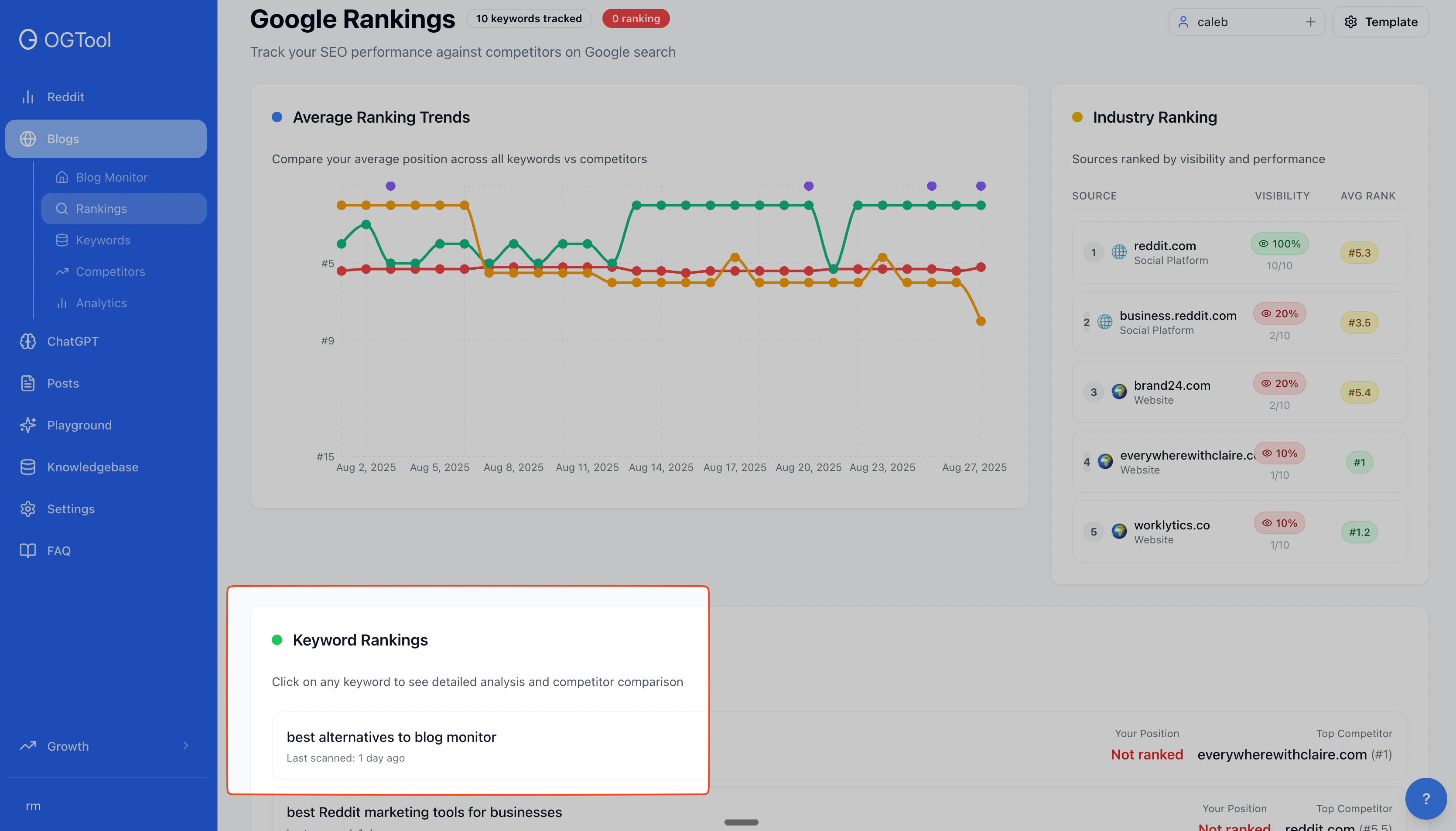
OGTool's dashboard tracks both Google ranking performance and ChatGPT citation gains in a single view.
What should you do with ChatGPT monitoring data once you have it?
Monitoring data is only valuable when it drives a specific next action. The three most productive uses are: identifying which competitor content earns citations on your target keywords so you can produce a more authoritative version, finding which of your existing pages are being pulled into AI responses so you can strengthen and update them, and discovering which prompts produce zero brand mentions so you can build content and Reddit presence to address them.
OGTool surfaces all three of these signals inside a single workflow. The competitor citation monitor shows you which rival articles ChatGPT is pulling from. The keyword tracker flags your citation gaps. The content and Reddit tools generate the assets to close those gaps. The citation alert confirms when the published content earns a mention. If you are looking for a full picture of what this loop looks like with revenue attribution, the case study on getting a client mentioned on ChatGPT in 24 hours walks through the specific steps taken and the result.
For teams that want a managed service rather than a self-serve platform, OGTool also runs the full cycle, including Reddit account management, weekly AEO blog production, and ongoing ChatGPT tracking, as described on the OGTool managed service page.
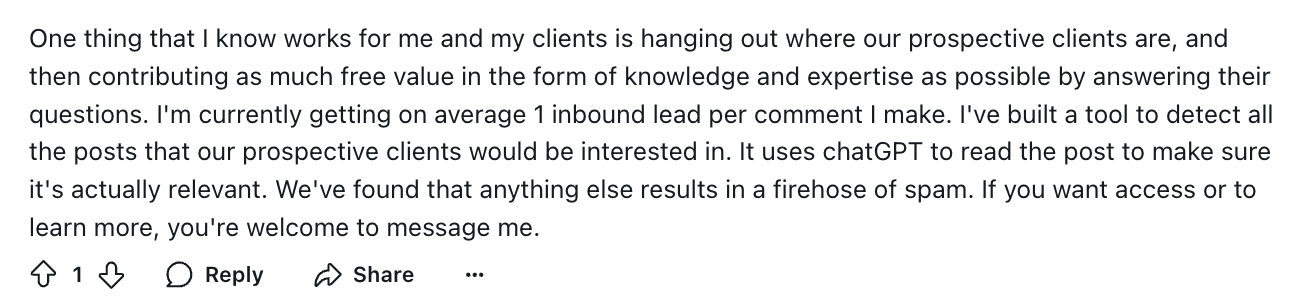
Strategic Reddit engagement, prioritized and drafted inside OGTool, generates inbound leads that feed back into ChatGPT citation signals.
FAQ
How do I check whether my brand appears in ChatGPT answers?
The manual method is to open a fresh ChatGPT session, run a set of prompts that match the questions your buyers actually ask, and record whether your brand name appears and in what context. For reliable trend data across multiple prompts and time periods, a dedicated monitoring tool is faster and more consistent. OGTool runs those checks daily and records the results in a searchable log. See the first-time setup guide for a step-by-step walkthrough.
Are there free tools for monitoring ChatGPT brand mentions?
SE Ranking offers a limited free trial, and LLMrefs provides a one-keyword free plan with restricted model access. Manual prompt checking in a new browser session costs nothing but produces inconsistent data over time. For teams tracking more than five queries with any regularity, a paid plan at $29/month and up is the practical starting point for reliable results.
Which ChatGPT monitoring tool also covers Perplexity, Gemini, and Google AI Overviews?
Otterly AI covers the widest range of engines at accessible pricing, including Google AI Overviews, Google AI Mode, ChatGPT, Gemini, Microsoft Copilot, and Perplexity starting at $29/month. Profound and SE Ranking also offer multi-engine coverage, though at different price points and team fit. If your primary goal is ChatGPT plus a content workflow that generates new citations, OGTool is the more direct fit.
Can my employer monitor my personal ChatGPT usage?
This is a separate question from brand visibility monitoring. Employers can monitor ChatGPT usage on company-owned devices and corporate accounts through IT and data-loss-prevention tools. Personal accounts on personal devices are outside that scope. The tools reviewed in this post are brand visibility trackers for marketing teams, not workplace monitoring or compliance software.
How is OGTool different from tools that only report on AI visibility?
Most monitoring tools deliver a report showing where your brand stands. OGTool adds the next step: it identifies which competitor articles earn citations on your target keywords, drafts the blog or Reddit content to compete for those citations, and then alerts you when your published content earns a mention. Documented outcomes from that full loop include a move from 3 percent to 72 percent AI share of voice and $282k in attributed revenue over 12 months for a YC-backed SaaS company.
What is an AI visibility tool and how does it differ from an AI rank tracker?
AI visibility tools measure whether your brand appears inside AI-generated answers across one or more LLMs. AI rank trackers are sometimes used as a synonym, though rank tracker implies a position number, which does not translate cleanly to AI answers the way it does to a Google results page. The more precise framing is share of voice, citation rate, and recommendation rate, which is how the stronger tools in this category now report results.
Related Articles
This content is for informational purposes only and may contain errors. Please contact us to verify important details.